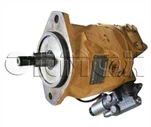
How is the abrasive wear caused in the hydraulic pump maintenance? For all hydraulic parts, there is a certain clearance for the coordination of internal accessories, because the working feature of hydraulic parts is that all accessories work in the medium, which is often referred to as hydraulic oil. During the design of hydraulic components, a set of mating pairs has a certain clearance. Oil film will be generated between mating pairs moving in the hydraulic oil, and the oil film will lubricate the mating parts to avoid wear of parts moving relatively.
Because the work of the hydraulic system depends on the oil pressure, the work between components not only has relative movement, but also maintains a certain oil pressure. The formation of its performance is attributed to the role of the oil film. Because of the viscosity of the medium, the thickness of the oil film is directly related to the viscosity and pressure. For example, when the viscosity is large, the thickness of the oil film will be thick, and the system can maintain high pressure: if the viscosity of the oil is small, the thickness of the oil film will be thin, or if the viscosity is small and the gap is large, there will be flow between the matching gaps, that is, the internal leakage of the hydraulic components, which is commonly known as internal leakage. Generally speaking, oil film is a protective film for flow.
Generally speaking, the materials of the mating parts of the hydraulic parts are different. For a component with a very hard and smooth surface, the materials of the mating parts are relatively soft; From the analysis of its working state, the hydraulic oil will hold on to the surface of soft materials, while the smooth and hard components will form a wear-free movement on its surface (the wear-free movement here is only relative, and there can be no wear-free movement in reality).
As there are particle impurities in the oil, with the relative movement of the components, the particulate pollutants will enter between the moving pair components with the hydraulic oil, and wear the surfaces of the two components at the same time. For example, in the working condition of a hydraulic cylinder, when the piston moves in the hydraulic cylinder, there is a set size oil film in the gap between the outer wall of the piston and the inner wall of the hydraulic cylinder. If the thickness of the oil film is 0.01mm, there is one or more impurities in the oil film, and the shape of the impurities is irregular. In a specific direction and time, the impurities will enter the oil film in the gap, and the maximum size of the impurities is greater than 0.01mm. According to the analysis of the oil pollutants used in the hydraulic pump, more than 20% of the contaminated particles are silica and metallized oxygen, which are the main components of the wear of pump parts, They are clamped in the middle of the surface of the moving pair parts. When the parts move relatively, it is equivalent to the effect of grinding sand, resulting in severe abrasive wear. For example, the hydraulic oil of the hydraulic system is mixed with some impurities for some reason, such as the process of changing the filter element, changing the pipeline, changing the joints and seals; During the relative movement of the friction pair, impurities will enter the gap between the friction pairs and wear the components.